Spokes v1.6.1: Custom HTTP Headers, URL Path Routing, and a Modernized Dashboard
Published at November 5, 2026 · 5 min read
Share on:We’re releasing Spokes v1.6.1 with new capabilities for HTTP traffic rules, plus a new webhook event and a refreshed dashboard.
This release lets you inject custom HTTP headers into proxied traffic, route URL paths to different upstreams or local webroots from a single traffic rule, and publish a webhook event when the server starts. Note that the new custom headers and URL path routing features require the upcoming Packetriot client v1.2.2. The dashboard also gets a visual refresh for a more modern look and feel.
What’s new:
- Custom HTTP headers: inject request headers into upstream traffic and response headers into client responses
- URL path routing: match request paths by prefix and route them to different upstreams or local webroots, with optional prefix stripping
- Server startup webhook: a new
serverStartupwebhook event that fires once after the server finishes starting up - Modernized dashboard: refreshed overview with stat cards, plus updated navigation and styling
- Dependency updates: updated
golang.org/x/*libraries
Get the Release
The latest software packages are now available on our downloads page. As always, we recommend upgrading to stay current with reliability improvements and security updates.
Our containers are updated as well.
docker pull packetriot/spokes:1.6.1

# alternatively

docker pull terrapinlabs/spokes:1.6.1
Dashboard Modernization
The Spokes dashboard has been given a visual refresh. The overview page leads with cards for uptime, version, hostname, alerts, restarts, availability, tunnels, traffic, and resource usage, and the sections have been reordered to surface the most useful information first.
Other improvements include an in-page submenu for configuration, a mobile dropdown menu, a transparent navigation bar over the overview canvas, and refreshed pagination styling across the connection information views. These are styling and layout changes only, and all existing behavior is unchanged.
The screenshot below shows the new overview page.
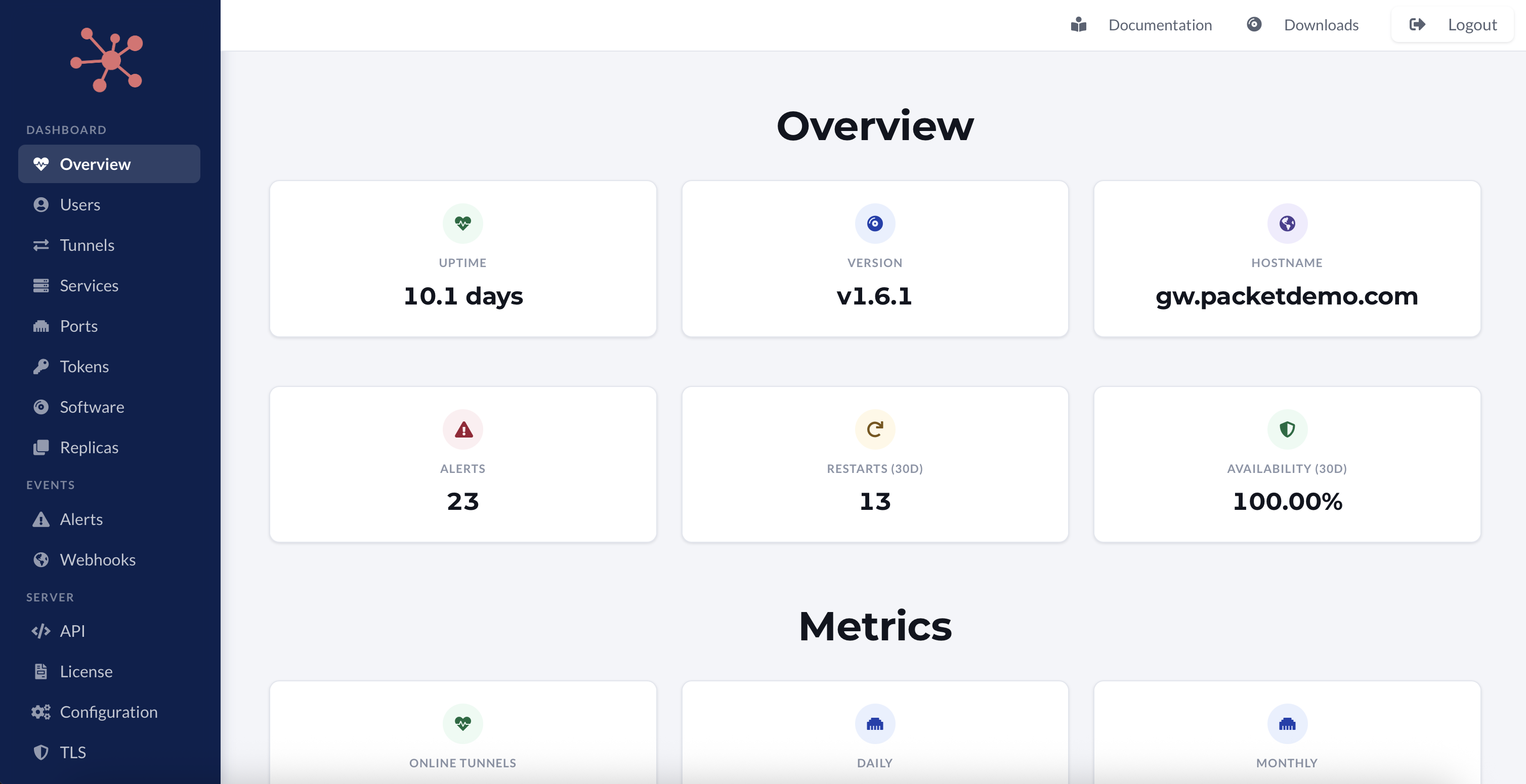
Updated overview page
Custom HTTP Headers
HTTP traffic rules now support custom header injection. Request headers are added to every request before it is forwarded to the upstream. Common uses include attaching API keys or authentication tokens to upstream requests and adding tracing headers to correlate requests across services.
Headers are configured directly on the traffic rule in the dashboard, with separate tables for request and response headers. Header names are validated against RFC 7230, so malformed entries are caught before they reach your traffic.
The screenshot below shows the Custom Headers section with a request header configured.
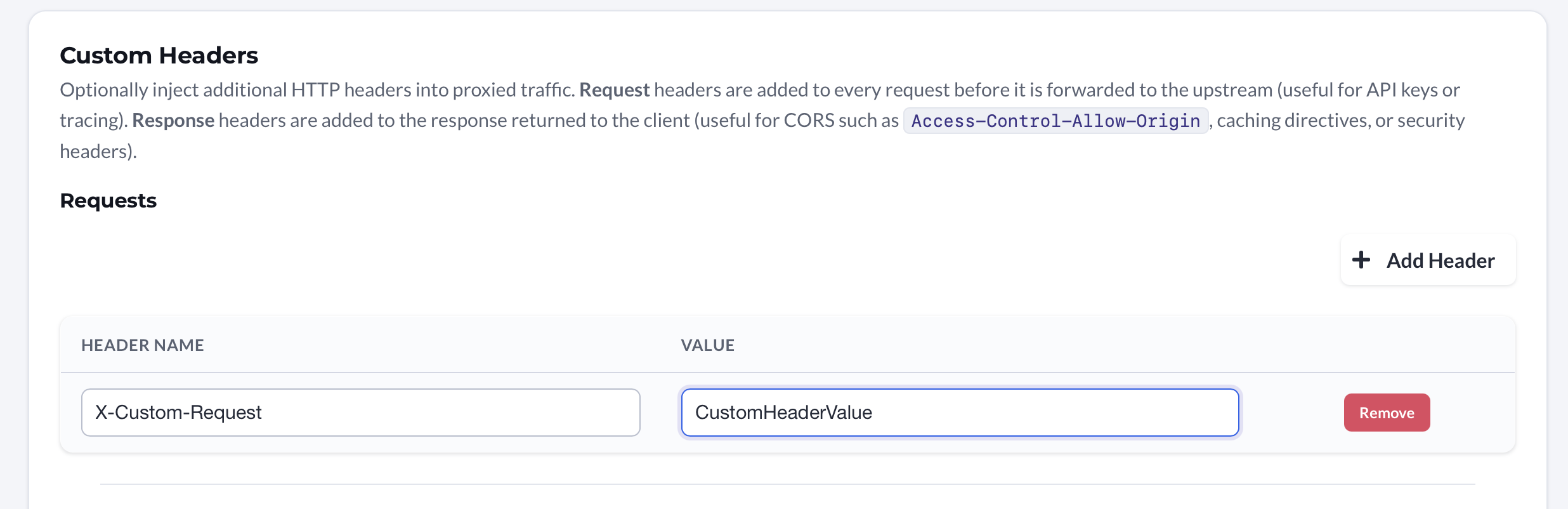
Custom request headers on a traffic rule
Response headers are added to the response returned to the client. Common uses include setting CORS headers such as Access-Control-Allow-Origin, controlling caching, or adding security headers on responses.
The screenshot below shows a response header configured on the same rule.
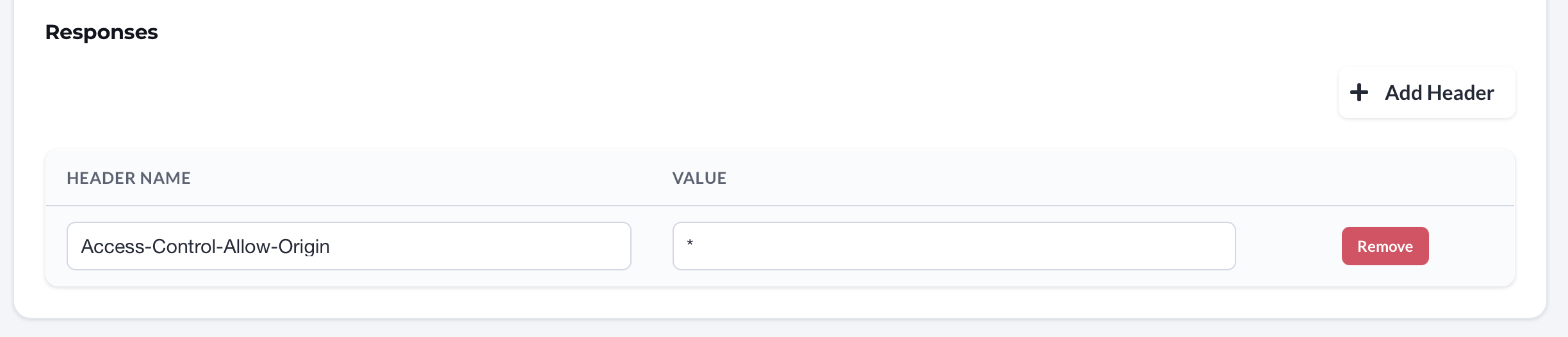
Custom response headers on a traffic rule
URL Path Routing
HTTP traffic rules also gain URL path routing. Each rule can now define a list of routes, where every route consists of a URL path prefix (for example /api) and a target, either an upstream URL or a local webroot for serving static content.
Requests are matched against the routes using longest-prefix matching. For each route you can optionally strip the matched prefix from the path before forwarding it to the upstream, so /api/users reaches the upstream as /users. Routes can also accept self-signed or otherwise invalid TLS certificates from the upstream.
If a request path doesn’t match any route, it falls back to the rule’s base upstream (upstream URL, destination and port, or webroot) exactly as before. This makes it straightforward to consolidate several services behind a single tunnel and subdomain. For example, you can send /api to an API server, /app to a backend, and everything else to a local webroot. No extra tunnels or services like nginx or Caddy required.
The screenshot below shows the URL path routing section with a few routes configured, including one targeting a local webroot and another targeting an upstream URL with insecure TLS enabled.
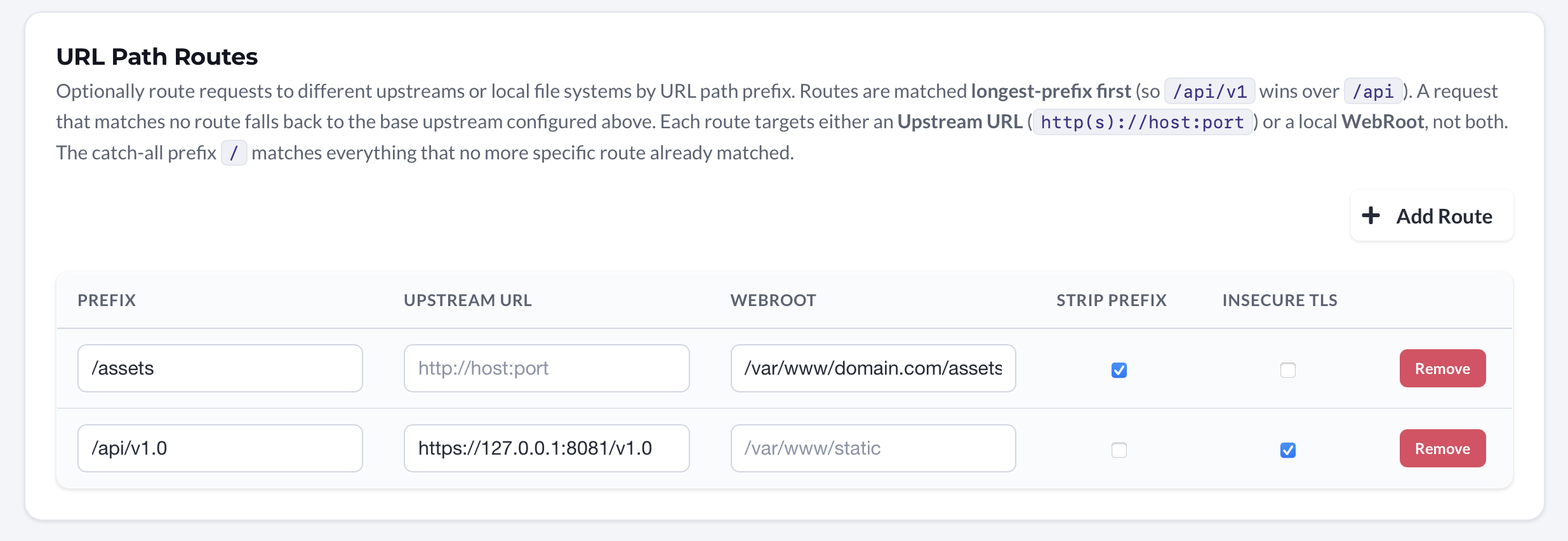
URL path routing on a traffic rule
These new capabilities also apply to the local HTTP services you can set up in Spokes. If you’re hosting services alongside Spokes and using it as a reverse proxy, you can now set custom request and response headers and route URL paths on those traffic rules.
Server Startup Webhook Event
Spokes now supports a new webhook event: serverStartup. The event is published once on server start, after all endpoints have been initialized.
You can enable it by checking the Server Startup checkbox under System Events on the webhook edit page. This is useful for notifying monitoring or automation systems that a server has finished booting. For example, after a crash or restart, your tooling can pick up the event without polling.
Dependency Updates
This release includes updates to the golang.org/x/* dependencies to keep Spokes aligned with current upstream releases and their security fixes.
There are no new settings or migration steps required. Just upgrade to the latest release to pick up the improvements.
Thanks
These improvements are part of our ongoing effort to make Packetriot’s software faster, simpler, and more reliable to operate.
We appreciate feedback, bug reports, and suggestions from our users. If there are features or improvements you’d like to see next, please let us know.
Cheers!